
Technical resources
Testing Whether Buyers Can Open and Handle a Microneedle Patch
A patch can leave its protective support bent, inverted or partly attached to a liner. Observe how intended users identify the array, remove the correct layers and handle the product before approving the retail presentation and instructions.
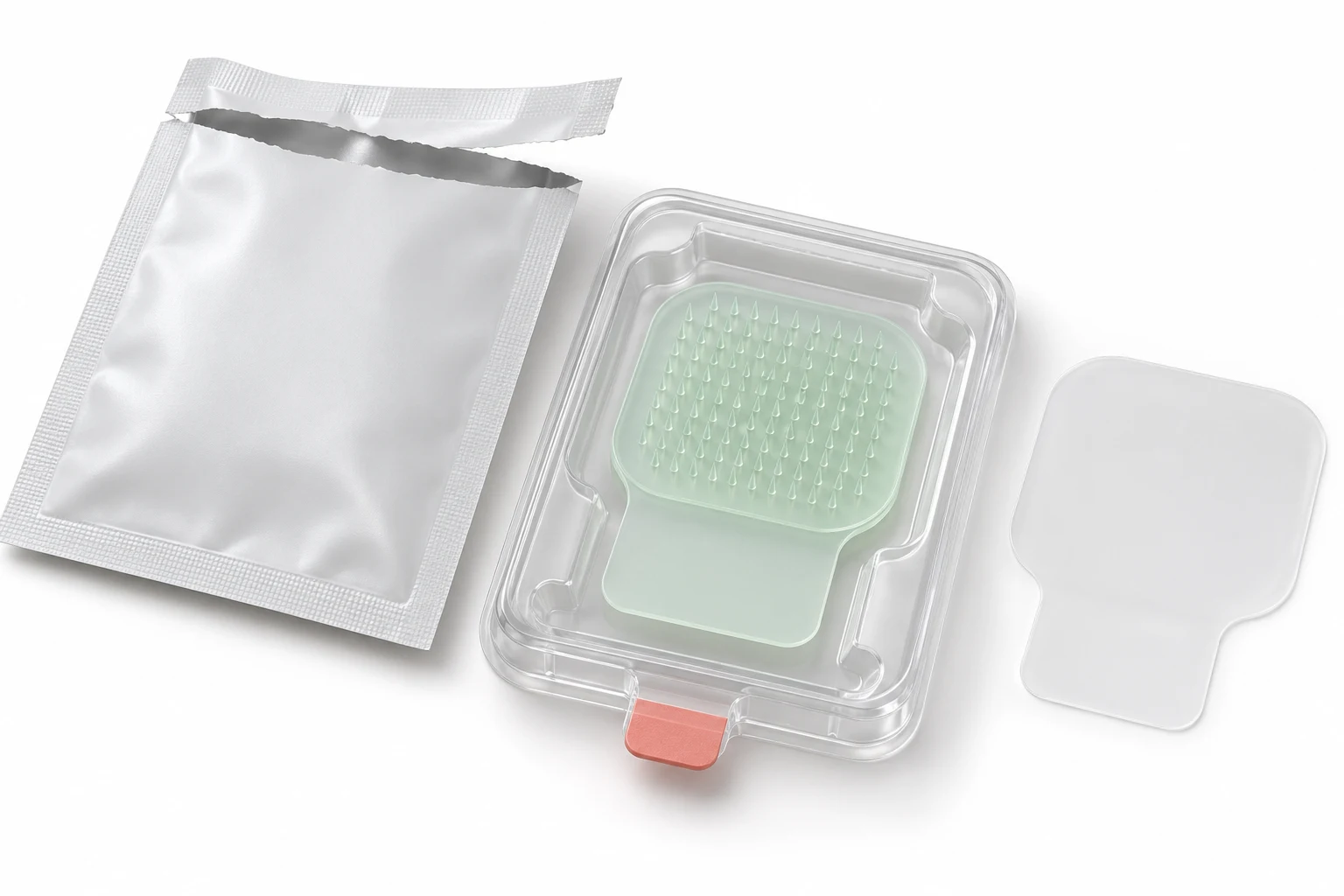
A user opens a microneedle patch and sees a protective tray, release liner and flexible backing. The product team knows which surface carries the array. A first-time buyer may mistake a removable protective piece for part of the patch or grip the projection area while trying to free it.
Study the fragile-array handoff
Define the task as moving the patch from its protected presentation into the ready-to-use state described by the approved instructions. This study can focus on opening and handling without asking participants to apply an unqualified prototype to skin. Any on-body work requires a separately approved protocol.
List the specific failure modes to observe: fingers contacting the array, bending the array while peeling, leaving an unintended liner in place, pulling away the functional backing, dropping the patch and misidentifying the application side. These are candidate observations for the actual design, not claims that every product has those faults.
Use the complete retail configuration
Provide the proposed tray, liner, pouch, printed instructions and patch revision together. A loose factory sample does not reproduce the opening sequence. Keep any rehearsal or training separate from the observations intended to represent a first encounter with the product.
A primary study of commercial microneedle integrity and mechanical properties examined product and packaging characteristics. It supports considering array condition alongside presentation. It does not demonstrate the usability or integrity of this site’s products, and its measured results should not become OEM acceptance limits.
Observe actions before offering help
Ask intended users to follow the supplied opening instructions and record their actions. Note where they search for an opening tab, which layer they remove first and where they place their fingers. A successful result after staff intervention should be recorded as assisted, with the assistance described.
Inspect array condition before and after the handling task using a defined method. Keep pre-existing observations separate from changes first seen afterward. If the array was not inspected initially, report that limitation rather than attributing every defect to the participant.
Make the instruction test design-specific
Check whether a drawing clearly distinguishes the projection-bearing surface from the liner and backing. Observe whether users interpret directional arrows as peeling, pressing or lifting. A translation can preserve the words while changing which layer a user believes should be removed.
FDA human-factors guidance concerns medical devices and intended users, uses and environments. Its task-observation approach is useful as a design reference here; this article does not classify the cosmetic-oriented project as a device or claim completion of device usability validation.
Revise the physical interaction when needed
If several participants grip the projection area because the removal tab is hard to distinguish, test a revised tab or support presentation. Adding another warning may not solve the observed physical difficulty. Keep the changed component and instruction revision linked to the next evaluation.
Record completion, assistance, wrong-layer removal and observed array damage separately. Completion time can provide context, but a fast opening that damages the array is not a successful handling outcome. Agree the decision criteria for the actual design before reviewing the results.
The existing release-specification guide addresses manufactured-unit acceptance. This study informs the custom presentation and instructions that allow a buyer to reach that unit without creating a new handling problem. It provides no universal application pressure or wear-time instruction.
Questions and answers
Can opening usability be studied without placing a prototype on skin?
Yes, a bounded study can end at the ready-to-use handling state. Define that endpoint and observe layer removal and array contact. Any on-body evaluation needs its own appropriate protocol and approval.
What if a participant removes the backing instead of the release liner?
Record the exact layer and sequence without silently correcting the result. Review whether the physical design or instructions made the layers distinguishable. Test a controlled revision when the failure warrants a change.
Does staff-assisted removal count as successful first-time handling?
Report it as assisted completion and describe the intervention. It can identify a useful design improvement, but it should not be combined with unassisted success when evaluating the supplied retail instructions.
How can the team tell whether handling damaged the array?
Use a defined inspection before and after the task and preserve the patch identity. Without a baseline, the team may observe damage but cannot confidently assign it to the participant’s opening action.
Why test translated liner instructions with the actual components?
Words for backing, liner and protective support can be interpreted differently. Observe which layer users actually remove in the target presentation. Linguistic review alone does not establish that the physical sequence is understood.